• About the blog
  • About Sedeer
  • Series
    • Words of Science
    • Discussions
    • Foraging
    • Natural Selection
    • QM Workshop
  • Contact me
  • Accumulating Glitches
  • Collective Marvelling

Inspiring Science

~ Casting light on great ideas

Inspiring Science

Category Archives: Insects

Become part of a research project about zombie ants!

21 Saturday Dec 2013

Posted by sedeer in Arthropods, Disease, Hymenoptera, Insects, Microbiology

≈ 4 Comments

Tags

Ant, ants, biology, Coryceps, crowd funding, fungus, manipulation, microbes, Microryza, mind control, Ophiocordyceps unilateralis, Parasitism, Popular science, Research, science, science and society

zombie ant fungus (Photo credit: pennstatenews)I’ve written about mind-controlling parasites and I’ve also written about ants a couple of times, but for some reason I still haven’t written about the famous “zombie ants“. These fascinating, macabre little wonders are ants that have been infected by a fungus (Ophiocordyceps unilateralis) which manipulates their behaviour. The fungus makes the ant climb up at plant stalk and bite into the underside of a leaf, clinging to it in a death grip. The fungus then kills the ant, consuming its innards before sending a reproductive stalk out through the corpse’s head.

I recently found out about an exciting research project looking into how the fungus manages its manipulation of the ant. Charissa de Bekker, a post-doc at Penn State University, is using Microryza to crowdfund her project, which will investigate what genes are active in the fungus’ manipulation of the ant. Since I think it’s an awesome project, I invited her to answer a few questions about herself and her work. Read on to find out what she has to say, and if you think the project sounds interesting or useful, consider backing it on Microryza — she’s got 11 days left to reach her goal! Continue reading →

The wasp and the cockroach: a zombie story

09 Thursday May 2013

Posted by sedeer in Arthropods, Hymenoptera, Insects

≈ 10 Comments

Tags

Ampulex, behaviour, biology, Emerald cockroach wasp, manipulation, nature, parasite, Parasitism, Parasitoid, Parasitoid wasp, Popular science, science

Ampulex compressa, commonly called Emerald Cockroach Wasp. Pictured in Dar es salaam, Tanzania. (Photo credit: Wikipedia)The world of parasites is full of incredible tales of manipulation and mind-control as these creatures twist their hosts to their needs.  Ever since I first heard of parasitoid wasps, I’ve been drawn to them by a delicious mixture of schadenfreude and intellectual fascination.  (Technically, parasitoids are slightly different from parasites, but that’s not important right now.)  Some of the examples of manipulation by parasitoid wasps are just wonderfully, horribly macabre.  I briefly mentioned the emerald cockroach wasp in a previous post; this time I’ll give a few other examples and explain the emerald wasp more thoroughly.  Hopefully I’ll manage to share some of my excitement about these amazing creatures, which made Darwin once write: “I cannot persuade myself that a beneficent and omnipotent God would have designedly created the Ichneumonidae [a group of parasitoid wasps] with the express intention of their feeding within the living bodies of caterpillars, or the cat should play with mice.”
Continue reading →

Sex and sociality: the genetics of being different

01 Friday Feb 2013

Posted by sedeer in Development, Genetics, Hymenoptera, Insects

≈ 7 Comments

Tags

Ant, Ant colony, ants, Chromosome, DNA, Fire ant, Gene, polygyny, Popular science, Queen ant, Red imported fire ant, science

Solenopsis invicta (Photo credit: AJC1)An international team of researchers studying fire ants have discovered the first “social chromosome”.  While this is obviously exciting to those of us who are fascinated by the advanced social organization of ants, the discovery also has broader implications.  The mechanism the researchers uncovered is similar to how sex is determined in many animals, creating the tantalizing possibility that it might be an example of a more general mechanism for evolving distinctly different complex behaviours. Continue reading →

Hsp90: translating environmental stress into evolutionary change

16 Sunday Dec 2012

Posted by sedeer in Development, Evolution, Form, Insects, Plants

≈ 3 Comments

Tags

biology, Developmental biology, Drosophila, evolution, Genetics, Hsp90, Insecta, Mutation, Phenotype, Popular science, shape

In the 1990s, Suzanne Rutherford and Susan Lindquist were studying fruit flies with a mutated version of the Hsp90 gene and found that the absence of this single gene led to a wide range of developmental defects.  This was surprising not only because Hsp90 isn’t directly related to development, but also because of the remarkable breadth of its impact.  Uncovering how this gene affects so many aspects of development has led to an intriguing story linking responses to environmental stress with the evolution of developmental pathways.
Continue reading →

How does an ant colony coordinate its behaviour?

28 Tuesday Aug 2012

Posted by sedeer in Complex systems, Hymenoptera, Insects, Modelling

≈ 53 Comments

Tags

animals, anternet, ants, Behavior, biology, complexity, emergence, emergent behavior, internet, network, Popular science, science

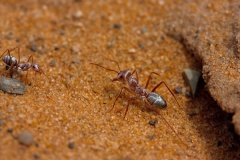
Two Cataglyphis workers meeting at the nest entranceA recent study looking at how colonies of ants regulate their foraging behaviour has caused a bit of a buzz online. A lot of the coverage has focused on a similarity highlighted in the press release, which says that the ants “determine how many foragers to send out of the nest in much the same way that Internet protocols discover how much bandwidth is available for the transfer of data”. While it’s wonderful that the study has received so much attention, I can’t help but feel that the really interesting aspect of this study has been overlooked in the excitement about the “anternet”. While the similarity between the two systems is striking, I’m more fascinated by a basic difference: unlike our computer networks, the regulation system in ants isn’t purposefully designed but emerges from uncoordinated decisions made by individuals.
Continue reading →

Social wasps are specialists at recognizing faces

16 Friday Mar 2012

Posted by sedeer in Evolution, Hymenoptera, Insects, Mind

≈ 3 Comments

Tags

animals, biology, Cognition, evolution, face, Facial recognition system, Insecta, Paper wasp, Popular science, science, Wasp

A young female paper wasp (Image via Wikipedia)There’s lots of evidence that humans have a specialized mechanism for identifying and responding to faces; for example, people with a condition called prosopagnosia have difficulty recognizing faces but not other objects.  A few years ago, researchers showed that individual paper wasps of the species Polistes fuscatus recognize each other’s faces; the same team has now gone on to show that, like humans, P. fuscatus accomplishes this via a specialized mechanism for facial recognition rather than through general shape or pattern recognition.  This story is an excellent example of a  complex cognitive ability being exhibited by a creature with a relatively simple nervous system.

Continue reading →

← Older posts
Newer posts →

Search

Donate Button with Credit Cards
Follow @inspiringsci
Follow Inspiring Science on WordPress.com

Enter your email address to follow this blog and receive notifications of new posts by email.

Join 1,699 other subscribers
RSS Feed RSS - Posts

Ongoing discussions

  • Is there evidence for natural selection? | Uncommon Descent on Natural selection: On fitness
  • istilah kesusastraan on Pointing ravens and theory of mind
  • hazratganj call girl on Pointing ravens and theory of mind
  • gomti nagar call girl on Pointing ravens and theory of mind
  • ghaziabad escorts on Pointing ravens and theory of mind
  • indore escorts nidhi nagar on Pointing ravens and theory of mind
  • wig price on Pointing ravens and theory of mind
  • aso agency on Pointing ravens and theory of mind

What’s popular now?

  • Telling left from right: which side gets the heart?
  • Natural selection: different modes
  • No secrets by the lakeside: how water affects sound
  • Redheads and pain: science or sensationalism?
  • What lies behind illusions?

Blogs to check out

  • Accumulating Glitches
  • alternative viewpoints
  • AntyScience
  • Baldscientist
  • Eyes on the Environment
  • Language Log
  • Letters of Note
  • naked capitalism
  • Raising My Rainbow
  • The Scorpion and the Frog
  • The Smaller Majority

Copyright

Creative Commons License
All text and original images by Sedeer El-Showk. Licensed under a Creative Commons Attribution-NonCommercial-NoDerivs 3.0 Unported License.

Thanks to

  • Arkadia International Bookshop
  • The Book Hive
  • The Television and Movie Store
  • Rönnels Antikvariat
Inspiring Science is part of:
  • Collective Marvelling
  • SciComm Network

I'm on ScienceSeeker-DNA

Nature
Blog Network

Categories

Archives

Blog at WordPress.com.

Privacy & Cookies: This site uses cookies. By continuing to use this website, you agree to their use.
To find out more, including how to control cookies, see here: Cookie Policy
  • Subscribe Subscribed
    • Inspiring Science
    • Join 1,699 other subscribers
    • Already have a WordPress.com account? Log in now.
    • Inspiring Science
    • Subscribe Subscribed
    • Sign up
    • Log in
    • Report this content
    • View site in Reader
    • Manage subscriptions
    • Collapse this bar
 

Loading Comments...
 

You must be logged in to post a comment.