Tags
animals, anternet, ants, Behavior, biology, complexity, emergence, emergent behavior, internet, network, Popular science, science
 A recent study looking at how colonies of ants regulate their foraging behaviour has caused a bit of a buzz online. A lot of the coverage has focused on a similarity highlighted in the press release, which says that the ants “determine how many foragers to send out of the nest in much the same way that Internet protocols discover how much bandwidth is available for the transfer of data”. While it’s wonderful that the study has received so much attention, I can’t help but feel that the really interesting aspect of this study has been overlooked in the excitement about the “anternet”. While the similarity between the two systems is striking, I’m more fascinated by a basic difference: unlike our computer networks, the regulation system in ants isn’t purposefully designed but emerges from uncoordinated decisions made by individuals.
Ants usually live in nests that can contain anywhere from a few dozen individuals to a few million. Food for the colony is provided by older ants who leave the nest to forage. Some species make foraging trails: long, tiny highways full of ants shuffling back and forth to bring food to the colony. These form when an ant returning with food lays down a special chemical (called a pheromone) on her way back to the nest; since the ants have a slight tendency to move towards the pheromone, they follow the chemical path and reinforce it, soon forming a trail. This shows how decisions made by individual ants (to follow the pheromone) can sum together to generate an overall behaviour that seems purposeful (forming a foraging trail). This kind of behaviour makes it possible for colonies to solve challenging problems, like finding the shortest path to food, without any kind of centralized planning or decision making.
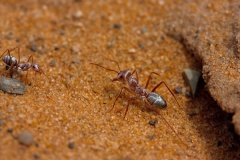
Finding food isn’t the only challenge facing an ant colony; they also have to deal with a variety of tasks ranging from maintaining the nest to moving to a new home. Just like everything else in the colony, the allocation of workers to different tasks has to be coordinated without any central planning. Understanding how this kind of decision making system works and evolves is an important and exciting field of research. A team of scientists at Stanford University addressed this question by investigating how colonies of the red harvester ant Pogonomyrmex barbatus regulate their foraging behaviour. Since P. barbatus feed on seeds which are scattered by winds and flood rather than being collected in patches, they forage individually rather than making trails. An ant returning with a seed drops it in the narrow entrance tunnel to the nest; she is then ready to go foraging again while another ant carries the seed deeper into the nest. Searching for food in the dry deserts of Arizona is an expensive proposition, so waiting ants decide when to leave the nest based on brief interactions with returning foragers, optimizing the colony’s resource usage.
To understand how this regulation works, the scientists measured how frequently ants went out foraging during a 20 minute observation period; for a few minutes out of this period, they prevented returning foragers from reaching the nest. By comparing the rate before, during and after the interruption, they discovered that the foraging rate depends on how often foragers return with food. This is very effective approach to regulation. If food is plentiful, the foragers will return quickly and recruit more ants to help; on the other hand, a scarce food supply will mean that foragers return more slowly, so fewer ants start foraging. The team used a mathematical model to test the idea that this behaviour was the result of decisions made by individual ants. In their model, ants leave the nest to forage at a certain rate which increases when other workers return and decreases as time passes, though it never drops below a fixed minimum. Since the results from the simulations were reasonably similar to the observations, it seems likely that the ants use something like this mechanism to decide when to forage.
Most of the media coverage about this study has focused on the similarity with the way traffic is regulated on computer networks. Professor Balaji Prabhakar, one of the authors of the paper, noticed the similarity with the Transmission Control Protocol (TCP) used by computers to find out how much bandwidth is available. Data sent using TCP has to be acknowledged by the receiving computer; the acknowledgement rate is used to estimate the quality of the connection. A low acknowledgement rate means there isn’t much bandwidth available, so the sender slows down the transmission rate. While this is an excellent example of ants and humans converging on the same solution to a problem, I think the really exciting part is the difference between the two systems.
While TCP was explicitly designed to solve a problem, the mechanism used by ants is emergent. Emergence, a feature of so-called “complex systems”, is when interactions between individuals lead to the appearance of a new behaviour or property at higher levels. Individual ants aren’t trying to find the shortest path to a food source or to optimize their colony’s foraging behaviour; they’re simply following a scent they like or going out to forage shortly after a nestmate returns with food. Nevertheless, the overall effect of these decisions is colony-level behaviour that looks just like a purposeful attempt to solve certain problems. This sort of emergence is an endless source of fascination to me. Complex systems tend to be both robust and flexible, which makes them ideal for everything from decision making to regulating development. Complexity theory provides a way to understand the behaviour of a wide range of dynamic systems, ranging from traffic flow and economics to weather. The plentiful computing resources available today have made it far easier to study these sorts of systems and to begin to understand the rich patterns and dynamics that emerge from this exhilarating and profoundly beautiful approach.
Ref
Balaji Prabhakar, Katherine N. Dektar, & Deborah M. Gordon (2012). The Regulation of Ant Colony Foraging Activity without Spatial Information PLoS Computational Biology, 8 (8) DOI: 10.1371/journal.pcbi.1002670
(Since it’s published in the PLoS journals, this article is open-access, meaning anyone can read it)


Pingback: How does an ant colony coordinate its behaviour? « Inspiring Science | SFFWRTCHT | Scoop.it
I found this very intresting. Thank you for putting this up.
I need to read more about complexity theory. Thank you for this interesting article.
You’re welcome; I’m glad you liked it! “Signs of Life” by Ricard Solé & Brian Goodwin is an excellent book about complex systems in biology — there’s even a chapter about ants. 🙂
really cool information .. I always wonder about an ant’s life when i see them marching on one of my drawers 😉 Thanks for sharing.,
You keep saying the ants are making decisions, but I find this rather far-fetched. Aren’t they simply acting on instinct in response to external stimuli?
Thanks for sharing your thoughts! I guess it depends on what you mean by “making a decision”. For example, I think it’s quite common to talk about Aritificial Intelligence systems making decisions even though they’re not conscious and are simply applying some kind of algorithm or ruleset.
Having said that, I’m not sure I’m willing to grant that ants (or other animals) are “simply acting on instinct in response to external stimuli” any more than we are. I don’t think we understand what consciousness is well enough to make that kind of statement. I know there’s a general tendency to think that humans are conscious and other animals aren’t (or perhaps are, to whatever extent they resemble humans), but I haven’t yet come across a convincing argument for that viewpoint.
So yeah, while I can say that ants are certainly making decisions in (at least) the same (limited) sense that an AI system does, I I can’t say for sure that they’re doing so consciously. In the absence of a convincing argument to the contrary, though, I take a broad-minded approach and give them the benefit of the doubt.
Very interesting!
Reblogged this on geekery and commented:
It’s pretty fascinating to see how such optimized and complex behaviours can result from simple individual actions in a colony.
It really is, isn’t it! I find the dynamics of these kinds of systems irresistably interesting…it’s a subject I’d like to learn more about during the rest of my PhD. When a theory can help clarify so many different phenomena (including the brain/mind), it starts to feel like you’re actually describing something fundamental. I find that kind of understanding really rewarding and I’m thrilled to have been able to share that sentiment!
Totally agree, and thanks for sharing. It’s one thing to be able to observe and describe such phenomena, but it takes things to another level when you’re able to learn about what others have named/found out about the same things too, exciting!
I study the ants or watch them on my lunch breaks at work, they are so fascinating.
Good Evening: This is what I like best about WP; engrossing posts on subjects of which I knew next to nothing and did not appreciate how fascinating they were.
Thanks; that’s exactly what I want to accomplish with my blog! If you haven’t already looked through my other articles, please do. Some of them might be a bit too technical (I’m trying hard to improve that…), but I hope you’ll find them interesting!
good ant, he.. he..
very interesting post. further amazes me how animals and creatures are so perfectly created.
interesting……there is a word that i can never remember that means “a single organism that is comprised of individual organisms”…loosly…….does anyone know what this word is?…………
i think superorganism explains whatb im trying to say but thats not theb word im looking for…………
Organisms like ants are called “eusocial”, but I don’t think that’s the word you’re looking for, is it? To be honest, I can’t think of another common word for what you’ve described than superorganism. Maybe metaorganism or metaindividual?
thanks for the reply….i guess the word is not that important …i think we both recognize the concept…thats the important bit…….interesting concept and method of living……the many forms of life on this planet are really fascinating….
Emergence?
Or maybe gestalt?
Reblogged this on jessejacksonmirega.
Very interesting article. I have always been intrigued by the ant society. This article was very though and answered many of my questions. thank you!
You’re welcome! If you have more questions, please ask! I’ve also got a “suggest a topic” link at the top if there’s another subject you’d like to read about…
Fascinating 🙂
I had not heard about the ants until I read this.
Thank you for sharing 🙂
That was indeed a very very interesting post. Enjoyed knowing about the insect I find doing march past around the sweets.Thanks for sharing.
I thought you were talking about my Ant , who see’s us a colony sometimes 😉 jk nice post interesting
Thanks for all the kind comments! I’m really glad so many people enjoyed this article and found it informative. Communicating science clearly to non-scientists is an important goal of mine, so it’s encouraging to see that I’m succeeding to some extent.
Very interesting read – thank you
wowl- explained very well!!!
Very interesting 🙂
As my favorite Vulcan would say, “Fascinating”… Seriously, this is remarkable, and I agree qith you when you say that the main point is that in an ant colony, this is emergent behavior. Could it be that engineers and ants just stumbled upon one of the optimal solutions to this particular problem? Thanks for the post!
I think you’re absolutely right about engineers & ants (and probably others, too) reaching very similar solutions; it’s a great example of convergence. I’m glad you liked the post!
It’s interesting… more pics would have made it reader-friendlier, imho,
Really intriguing! And this is a cool subject that I can talk about with my boys. They will think I know everything….just like the good old days :-). Thanks!
i used to sit outside as a child and watch the ant walking in a straight line to their destination. i would put something in the middle of the line and watch them all be surprised and walk around it or over it but never deviating or breaking it. in a way, it is loyalty and trust. loyal to the colony and trusting the ant in front to lead them in the right direction.
great post! thank you for sharing!
Pingback: How does an ant colony coordinate its behaviour? « Live, Laugh, Love
Wonderful! I’ve always been fascinated by ant colony behavior after reading Kropotkin’s Mutual-Aid. I like the fact that there’s an organized, but not centralized, method of preserving the well-being of the whole colony. Just goes to show that mutual-support and cooperation gives the best insurance for social survivability. 😀
This is awesome, really gets me thinking !!!
If anyone is interested in my blog its here
BTW im going to reblog this …..Its to good to leave
http://[email protected]
sorry wrong address
http://simplysciencenews.wordpress.com
Pingback: Ants Use The Internet? | #PCO News - Bulwark Ext
This is Fascinating. Thanks to who ever wrote this because I was just about to write an article on this little creatures and really had no much information so this really helped. Thumbs up ones again.
You’re welcome! I’m glad the article was helpful to you.
Pingback: Call to Arms « myothervoices
Pingback: Week 3 – Project 2 Research – Computer Drawing « Jo Jarvis
Woah! Thank GOD I found this blog. I would use the little knowledge I gained from this in written a fable about ants.
In case u need d best writer for your movie, drama and so on. Just holla this bb pin: 21647f3c and e-mail; [email protected]. U can call this mobile number +2348104720050.
Pingback: Become part of a research project about zombie ants! | Inspiring Science
Pingback: Genetics Determine Division of Labor in Ants
Pingback: Project Definition: The Travelling Salesman Problem | Modelling in science at Dawson (2014)
Pingback: How To Get Rid of Ants (COMPLETE GUIDE) - Pest Strategies
Pingback: Genetics Determine Division of Labor in Ants - Guardian Liberty Voice
Pingback: sloth meaning in malayalam