How does an ant colony coordinate its behaviour?

Tags

, , , , , , , , , , ,

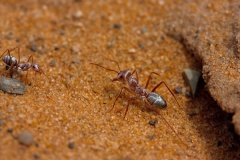
Two Cataglyphis workers meeting at the nest entranceA recent study looking at how colonies of ants regulate their foraging behaviour has caused a bit of a buzz online. A lot of the coverage has focused on a similarity highlighted in the press release, which says that the ants “determine how many foragers to send out of the nest in much the same way that Internet protocols discover how much bandwidth is available for the transfer of data”. While it’s wonderful that the study has received so much attention, I can’t help but feel that the really interesting aspect of this study has been overlooked in the excitement about the “anternet”. While the similarity between the two systems is striking, I’m more fascinated by a basic difference: unlike our computer networks, the regulation system in ants isn’t purposefully designed but emerges from uncoordinated decisions made by individuals.
Continue reading
Inspiring Science has joined Collective Marvelling

I started this blog not only as an outlet for my writing but, more importantly, as an effort to demystify science to the lay reader. Of course, I’m far from alone in this sentiment; there are plenty of science blogs each trying to communicate some part of this immense undertaking. Collective Marvelling is a network of blogs written by young researchers, an attempt to bring together discussions that might otherwise happen in disparate places. Snippets from each member blog are cross-posted on CM, making it a central resource for science news. I’ve joined the network and added a link to Collective Marvelling at the top and in the sidebar. Go ahead and have a look; it’s already aggregating content from the excellent The Trenches of Discovery, Blank on the Map, Cross Sections and Lumps ‘N’ Bumps

Words of science: alluvium

Tags

, , , , , , , , ,

Like many other fields, science has its own style of communication full of specific jargon and guided by unwritten rules.  Most of the posts on this blog focus on breaching this barrier to the public’s understanding and appreciation of science.  In this series, I’d like to take another approach by highlighting scientific words which have escaped (or should escape!) the confines of jargon to reach a broader appeal because of their sound or their evocative power as metaphors.  Today’s word is alluvium.  [Previous words: petrichor]
Continue reading

Promoting incompetence

Tags

, , , , , , , , ,

From Dilbert’s PHB to The Office, the incompetent manager is such a popular trope that it’s in danger of becoming a tired cliché. Is this just a sign of the times or might it reflect some deeper truth? Could this be because of how we decide who to promote? A recent study has confirmed a counter-intuitive idea proposed over 30 years ago — that promoting those who perform best may, in fact, be a losing strategy.
Continue reading

Still writing!

Tags

I’m not sure if this blog ever had a loyal readership, but if so I’ve probably managed to lose most of it thanks to the extended hiatus.   It may seem like I’ve abandoned this project, but I certainly don’t intend to.  I’m sorry for the long and unexpected break; the past few months have been far busier than I anticipated and I simply haven’t managed to make the time to write.  I’ve been collecting stories to write about, though, and have some interesting posts planned.  I’m also eager to continue the serial posts, especially Words of Science.  Now that I’ve (finally!) started writing again, I’m determined to keep to a schedule of 1-2 posts per week; I hope you’ll keep reading!

Found while foraging (June 13, 2012)

Tags

, , , , , , , ,

I’m sorry that I haven’t been posting regularly lately — I’ve been unexpectedly busy with “real life” lately.  Things seem to have settled down a bit, so hopefully I’ll be back to my normal frequency soon.  In the meantime, here’s a collection of various things I’ve come across recently. Continue reading