• About the blog
  • About Sedeer
  • Series
    • Words of Science
    • Discussions
    • Foraging
    • Natural Selection
    • QM Workshop
  • Contact me
  • Accumulating Glitches
  • Collective Marvelling

Inspiring Science

~ Casting light on great ideas

Inspiring Science

Tag Archives: Popular science

Beacon: mantis shrimp and more…

26 Wednesday Feb 2014

Posted by sedeer in Blog

≈ Leave a comment

Tags

ants, biology, communicating science, crowd funding, evolution, journalism, Kickstarter, mantis shrimp, Popular science, science, science and society, Science journalism, writing

Here’s a taste of what I’ve been writing on Beacon so far. It’s been enormously fun so far, and the focus is a bit different from what I post on here. I’ve got lots of other great story ideas coming up for Beacon; I’m looking forward to researching them and sharing what I find with my subscribers. For now, here are a few excerpts from my first few stories to entice those of you who might be on the fence:

Fit for a Queen
In this short creative nonfiction piece, a young queen sets off into the dangerous world alone. Burdened with her people’s future, she has to persevere in the hope that help will arrive in time. 

The young queen had to find shelter soon. Everything depended on that. Stumbling, she scrambled over the rough ground as she looked for a place to hide — a crevice or even just a protective overhang. She spotted a fissure in the rocks ahead and made for it, a crack just wide enough for her to squeeze through. Safe at last, she slowed down, conserving her energy for the task ahead. Continue reading…

Through Alien Eyes
Mantis shrimp, famous for their lightning-quick punch, also have the most advanced eyes we know about and a fundamentally different approach to vision. Get a glimpse of how they see the world.

If we were designed in God’s image, it’s hard to imagine what model inspired the mantis shrimp, but it must have been pretty impressive. Heavily armoured and formidably armed, these marine crustaceans kill their prey — molluscs, crustaceans, and small fish — with a strike that accelerates as fast as a .22 calibre bullet. They look out at the world with a pair of eyes mounted on stalks which they can move independently, tracking an object with one eye while scanning their surroundings with the other. One researcher described the effect as “most uncrustacean-like, suggesting an almost ‘primate-like’ awareness of their surroundings.” Continue reading…

A Grander View
In a world that’s brimming over with life, we often think of ourselves as somehow special. Join me on a journey of exploration through the lives and evolution of the other creatures on Earth. Along the way, we’ll discover that the living world is infused with a richness of marvels, of which we are just a small part.

It all started with agriculture. Or maybe fire. Or was it the first time we used language? The truth is that I don’t know when it started and I won’t pretend to, but at some point we invented the conceit of human exceptionalism and that myth has grown ever since. It’s infiltrated our language and permeates our thoughts, shaping how we see the world. Seduced by our ingenuity, we imagine ourselves as apart from the rest of the world, elevated above it or at least dominant within it. Continue reading…

Dying for sex

12 Wednesday Feb 2014

Posted by sedeer in Evolution, Mammals

≈ Leave a comment

Tags

animals, Behavior, biology, Education, evolution, mating, Popular science, reproduction, science, sex

Unfortunately, I’ve been too busy to attend to Inspiring Science this week. Rather than putting out a rushed post, I decided to republish this piece which I originally wrote for Accumulating Glitches last year. I hope you like it!

(Photo credit: Michael Barritt & Karen May, via Wikimedia Commons)Some spiders get eaten by their mates, and male salmon famously fight to the death for access to females, but we generally don’t think of reproduction being quite as risky for mammals. We may prance and pose or jockey for attention, and mating might even be quite painful, but it’s usually not lethal. Among mammals, “live to mate another day” seems to be the guiding principle. Exceptions to this rule are found in the dasyurids and didelphids, groups of small carnivorous marsupial species living in Australia and South America, respectively. “These species experience extreme sexual behaviour,” said Dr. Diana Fisher of the University of Queensland. Males and females mate with multiple partners and matings can go on for many hours. Afterwards, the males all die. Continue reading →

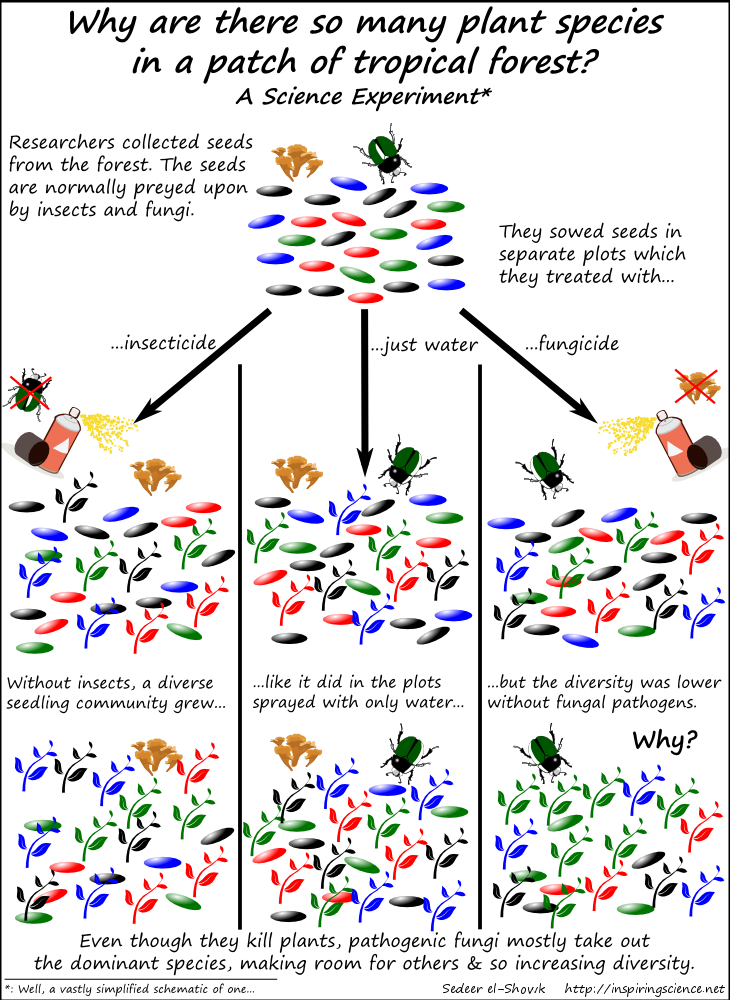
Why are there so many plant species in tropical forests?

29 Wednesday Jan 2014

Posted by sedeer in Conservation, Evolution, Insects, Plants

≈ 5 Comments

Tags

biology, density, diversity, forests, fungi, pathogen, plants, Popular science, science, tropical forests

Diversity in Forests Continue reading →

Update on my Beacon project — goal reached!

28 Tuesday Jan 2014

Posted by sedeer in Blog

≈ Leave a comment

Tags

biology, communicating science, crowd funding, journalism, Kickstarter, Popular science, science, science and society, Science journalism, writing

With a couple of days left to go, we’ve already got more than enough backers to launch my Beacon project! A huge “thank you!” to each of you who contributed, whether by joining the project or spreading the word. Many of my backers came via your Facebook posts and the emails you sent out. Thanks for helping get my first crowd-funding experience off to a great start — I couldn’t have done it without you! And if somebody wants to sign up but hasn’t yet, they still can.

Thanks,
Sedeer

We’re getting closer to a malaria vaccine

24 Friday Jan 2014

Posted by sedeer in Humans, Immunology

≈ Leave a comment

Tags

biology, Education, Health, Human, immunity, malaria, mosquito, Popular science, science, Science communication, vaccination, vaccine

Malaria parasite (photo courtesy Wikipedia)Malaria hardly needs an introduction. With over 200 million people infected, it takes the life of an African child every minute. Although we have drugs to help treat the disease, there isn’t an effective vaccine available, partly due to the malaria pathogen’s variability. Now, a research collaboration between labs in the US and Australia has brought a step closer to that goal by figuring out how to produce a vaccine which works against many different strains. Continue reading →

Update on my Beacon project — 8 days to go!

22 Wednesday Jan 2014

Posted by sedeer in Blog

≈ Leave a comment

Tags

biology, communicating science, crowd funding, journalism, Kickstarter, Popular science, science, science and society, Science journalism, writing

First of all, I’d like to say a big “Thank you!” to everyone who’s already joined my project or shared the link. With your help, we’ve gotten a quarter of the way there in just six days. That’s a great start, but we’ll need to pick up the pace to hit the target on time! Continue reading →

← Older posts
Newer posts →

Search

Donate Button with Credit Cards
Follow @inspiringsci
Follow Inspiring Science on WordPress.com

Enter your email address to follow this blog and receive notifications of new posts by email.

Join 1,699 other subscribers
RSS Feed RSS - Posts

Ongoing discussions

  • Is there evidence for natural selection? | Uncommon Descent on Natural selection: On fitness
  • istilah kesusastraan on Pointing ravens and theory of mind
  • hazratganj call girl on Pointing ravens and theory of mind
  • gomti nagar call girl on Pointing ravens and theory of mind
  • ghaziabad escorts on Pointing ravens and theory of mind
  • indore escorts nidhi nagar on Pointing ravens and theory of mind
  • wig price on Pointing ravens and theory of mind
  • aso agency on Pointing ravens and theory of mind

What’s popular now?

  • Telling left from right: which side gets the heart?
  • Natural selection: different modes
  • No secrets by the lakeside: how water affects sound
  • What lies behind illusions?
  • Redheads and pain: science or sensationalism?

Blogs to check out

  • Accumulating Glitches
  • alternative viewpoints
  • AntyScience
  • Baldscientist
  • Eyes on the Environment
  • Language Log
  • Letters of Note
  • naked capitalism
  • Raising My Rainbow
  • The Scorpion and the Frog
  • The Smaller Majority

Copyright

Creative Commons License
All text and original images by Sedeer El-Showk. Licensed under a Creative Commons Attribution-NonCommercial-NoDerivs 3.0 Unported License.

Thanks to

  • Arkadia International Bookshop
  • The Book Hive
  • The Television and Movie Store
  • Rönnels Antikvariat
Inspiring Science is part of:
  • Collective Marvelling
  • SciComm Network

I'm on ScienceSeeker-DNA

Nature
Blog Network

Categories

Archives

Create a free website or blog at WordPress.com.

Privacy & Cookies: This site uses cookies. By continuing to use this website, you agree to their use.
To find out more, including how to control cookies, see here: Cookie Policy
  • Subscribe Subscribed
    • Inspiring Science
    • Join 1,699 other subscribers
    • Already have a WordPress.com account? Log in now.
    • Inspiring Science
    • Subscribe Subscribed
    • Sign up
    • Log in
    • Report this content
    • View site in Reader
    • Manage subscriptions
    • Collapse this bar
 

Loading Comments...
 

You must be logged in to post a comment.