• About the blog
  • About Sedeer
  • Series
    • Words of Science
    • Discussions
    • Foraging
    • Natural Selection
    • QM Workshop
  • Contact me
  • Accumulating Glitches
  • Collective Marvelling

Inspiring Science

~ Casting light on great ideas

Inspiring Science

Author Archives: sedeer

Music, Memory, and Voices

18 Wednesday Sep 2013

Posted by sedeer in Humans

≈ 6 Comments

Tags

biology, evolution, Human, Melody, music, Musical instrument, Popular science, science, Singing, Vocal music

Photo credit: Hannele Luhtasela-el ShowkHumans are remarkably talented musicians. We can recognize a tune despite changes like being slowed down or sped up or even if all of the notes are shifted to a higher or lower pitch. Though these may seem like trivial feats, most other animals can’t manage them. Experiments have shown that six-month old human babies can already distinguish musical pitch and recognize shifted melodies. These exceptional abilities suggest that humans might have some innate capacity to perceive and understand music, something like our hypothetical language faculty. Given that we’ve been able to sing for much longer than we’ve had musical instruments, it seems reasonable that any music capacity we evolved would be more attuned to vocal than instrumental music. Continue reading →
Kickstarter campaign: The Universe Verse

17 Tuesday Sep 2013

Posted by sedeer in Books

≈ 2 Comments

Tags

book, children's book, Coloring book, comic, evolution, Kickstarter, Popular science, Rhyme, Science communication

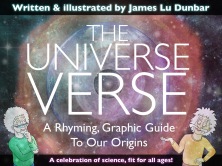
Universe_VerseLast week I got an email from James Dunbar, an author and illustrator, asking me to promote the Kickstarter campaign for his new book, The Universe Verse.  It’s a series of three rhyming “graphic guides” (i.e., comic) covering the origin of the Universe, the origin of life on Earth, and the evolution of humans. Dunbar describes the books as “scientifically accurate” and “targeted at children and fun-loving adults”.  I got a PDF preview of the book; I didn’t read through the entire thing, but the parts I saw looked engaging and educational.  The rhymes and rhythms did feel a bit forced at times, but that’s hardly surprising — I’m sure it’s not easy to keep that up for three whole books!

Dunbar has already met his initial goal ($10,000), but if the campaign reaches $25,000 he’ll release a coloring-book version of all three books as a free PDF.  I think these books could be a great resource for kids and young adults.  Rhymes, pictures, and a storyline can help make the material more palatable and memorable, and I can see that they would be a wonderful way to get kids interested in and educated about science.  I contributed to the Kickstarter because I’d like to see them become available even to disenfranchised communities.  If you feel the same way, consider chipping in if you can afford it.

Click through to see a couple of sample pages…

Book review: Raising My Rainbow

17 Tuesday Sep 2013

Posted by sedeer in Books, Humans, Mind

≈ 4 Comments

Tags

Barbie, book, book review, family, gender, Human, LGBTQ, Lori Duron, rainbow, sex, sexism

Image: Random HouseI discovered the blog Raising My Rainbow sometime last year and have been reading it (semi-)regularly ever since. Written by Lori Duron, it chronicles the ups and downs of raising CJ, a gender-creative little boy who “only likes girl stuff and wants to be treated like a girl”. The blog has been enormously popular and successful, leading Duron to write a book of the same name. Continue reading →

Through the Looking Glass

11 Wednesday Sep 2013

Posted by sedeer in Humans

≈ 2 Comments

Tags

Behavior, behaviour, Cognition, games, immersion, Joy Division, MMOG, MMORPG, Popular science, science, University of Malta, Video game, virtual worlds, Will Love Tear Us Apart, World of WarCraft

Instead of writing a post for Inspiring Science this week, I decided to share my first published feature article with you! It appeared in Issue 6 of Think magazine, which was published on Monday. I wrote about the research of Gordon Calleja, director of the Institute of Digital Games at the University of Malta, and also reviewed Will Love Tear Us Apart, a game he designed based on Joy Division’s song Love Will Tear Us Apart. You can read my feature below and also check out the other articles in the issue (it’s free!) and visit the magazine on Facebook!

Gordon Calleja has a dream job: he studies video games. It may sound like frivolous fun, but his work is serious research. He examines how people perceive the world around them and interact with it. His research blends aspects of philosophy, neuropsychology, and literary theory with futuristic concepts like cybernetics and post-humanism; his papers are peppered with references to Wittgenstein and Borges alongside quotes from avid gamers. In his book In-Game: From Immersion to Incorporation, published last year by MIT Press, Professor Calleja tackles the question of how we experience games – how the barrier created by the screen and the controls dissolves into a sense of really being there. ‘Ultimately,’ he says, ‘studying presence in games is asking how we are conscious here in the physical world.’

Continue reading…

Understanding Intelligence

28 Wednesday Aug 2013

Posted by sedeer in Mind

≈ 4 Comments

Tags

Alan Turing, Artificial intelligence, computer science, intelligence, Popular science, science, Turing Test

Photo credit: WikipediaFrom Siri answering our questions and Watson advising nurses to smart apps that aggregate information to help us out (or spy on us), artificial intelligence is transforming our world. Despite incredible advances, somehow these amazingly “intelligent” systems sometimes seem profoundly stupid. Hector Levesque, a professor of computer science at the University of Toronto, likens them to savants. He was recently awarded the Research Excellence Award at the International Joint Conference on Artificial Intelligence in Beijing; he used his acceptance speech to highlight important questions about our approach to artificial intelligence and what it can tell us about ourselves. Continue reading →

The laws of biology

26 Monday Aug 2013

Posted by sedeer in Discussions

≈ 14 Comments

Tags

biology, Law, philosophy, philosophy of science, physics, science

Science is our way of trying to understand the universe, to make sense of the patterns of objects and behaviours around us and explain the regularity of the world we experience. We use several different words to characterize the ideas and explanations we come up with. A hypothesis is an informed conjecture, a speculation about world which needs to be tested, while a theory is a well-supported, coherent framework which explains some aspect of the universe. Scientific “laws” seem to fall somewhere in between; while they’re very well-supported, they tend to assert things about the world rather than offer an explanation. For example, Newton’s law of gravity enables us to predict the gravitational attraction between two objects but doesn’t explain why objects are attracted to each other. Continue reading →

← Older posts
Newer posts →

Search

Donate Button with Credit Cards
Follow @inspiringsci
Follow Inspiring Science on WordPress.com

Enter your email address to follow this blog and receive notifications of new posts by email.

Join 1,699 other subscribers
RSS Feed RSS - Posts

Ongoing discussions

  • Is there evidence for natural selection? | Uncommon Descent on Natural selection: On fitness
  • istilah kesusastraan on Pointing ravens and theory of mind
  • hazratganj call girl on Pointing ravens and theory of mind
  • gomti nagar call girl on Pointing ravens and theory of mind
  • ghaziabad escorts on Pointing ravens and theory of mind
  • indore escorts nidhi nagar on Pointing ravens and theory of mind
  • wig price on Pointing ravens and theory of mind
  • aso agency on Pointing ravens and theory of mind

What’s popular now?

  • Telling left from right: which side gets the heart?
  • Redheads and pain: science or sensationalism?
  • Whose genome is it anyway?
  • No secrets by the lakeside: how water affects sound
  • Words of science: alluvium

Blogs to check out

  • Accumulating Glitches
  • alternative viewpoints
  • AntyScience
  • Baldscientist
  • Eyes on the Environment
  • Language Log
  • Letters of Note
  • naked capitalism
  • Raising My Rainbow
  • The Scorpion and the Frog
  • The Smaller Majority

Copyright

Creative Commons License
All text and original images by Sedeer El-Showk. Licensed under a Creative Commons Attribution-NonCommercial-NoDerivs 3.0 Unported License.

Thanks to

  • Arkadia International Bookshop
  • The Book Hive
  • The Television and Movie Store
  • Rönnels Antikvariat
Inspiring Science is part of:
  • Collective Marvelling
  • SciComm Network

I'm on ScienceSeeker-DNA

Nature
Blog Network

Categories

Archives

Create a free website or blog at WordPress.com.

Privacy & Cookies: This site uses cookies. By continuing to use this website, you agree to their use.
To find out more, including how to control cookies, see here: Cookie Policy
  • Subscribe Subscribed
    • Inspiring Science
    • Join 1,699 other subscribers
    • Already have a WordPress.com account? Log in now.
    • Inspiring Science
    • Subscribe Subscribed
    • Sign up
    • Log in
    • Report this content
    • View site in Reader
    • Manage subscriptions
    • Collapse this bar
 

Loading Comments...
 

You must be logged in to post a comment.