• About the blog
  • About Sedeer
  • Series
    • Words of Science
    • Discussions
    • Foraging
    • Natural Selection
    • QM Workshop
  • Contact me
  • Accumulating Glitches
  • Collective Marvelling

Inspiring Science

~ Casting light on great ideas

Inspiring Science

Tag Archives: Behavior

Through the Looking Glass

11 Wednesday Sep 2013

Posted by sedeer in Humans

≈ 2 Comments

Tags

Behavior, behaviour, Cognition, games, immersion, Joy Division, MMOG, MMORPG, Popular science, science, University of Malta, Video game, virtual worlds, Will Love Tear Us Apart, World of WarCraft

Instead of writing a post for Inspiring Science this week, I decided to share my first published feature article with you! It appeared in Issue 6 of Think magazine, which was published on Monday. I wrote about the research of Gordon Calleja, director of the Institute of Digital Games at the University of Malta, and also reviewed Will Love Tear Us Apart, a game he designed based on Joy Division’s song Love Will Tear Us Apart. You can read my feature below and also check out the other articles in the issue (it’s free!) and visit the magazine on Facebook!

Gordon Calleja has a dream job: he studies video games. It may sound like frivolous fun, but his work is serious research. He examines how people perceive the world around them and interact with it. His research blends aspects of philosophy, neuropsychology, and literary theory with futuristic concepts like cybernetics and post-humanism; his papers are peppered with references to Wittgenstein and Borges alongside quotes from avid gamers. In his book In-Game: From Immersion to Incorporation, published last year by MIT Press, Professor Calleja tackles the question of how we experience games – how the barrier created by the screen and the controls dissolves into a sense of really being there. ‘Ultimately,’ he says, ‘studying presence in games is asking how we are conscious here in the physical world.’

Continue reading…

How are humans like ants?

15 Wednesday May 2013

Posted by sedeer in Complex systems, Humans, Language, Mind

≈ 8 Comments

Tags

Behavior, brain, Cognition, Human, language, People, Popular science, science and society

Last year, I wrote about how some ants can find their way home after finding food.  They have the remarkable ability to account for all the twists and turns they made while foraging and calculate a direct path leading straight back to their nest.  A reader emailed to ask if I thought humans would ever be able to do something similar or to achieve the level of co-ordination shown by ants.  This post is based on my reply, where I pointed out several things that humans are amazingly good at doing  — in fact, we do them so well and with such ease that you might be surprised by how difficult they actually are!  I’ve spent a lot of time on Inspiring Science talking about behaviours and abilities which show that other animals aren’t just simple automata because I think it’s important to make the point that although humans are unique, we aren’t special; we’re just another species with our own particular tricks for surviving in this world.  I’ll take a different tack in this post and talk about some of the ways we stand out! Continue reading →

What makes you who you are?

14 Thursday Feb 2013

Posted by sedeer in Discussions, Humans

≈ 24 Comments

Tags

Behavior, biology, Emerald cockroach wasp, identity, Parasitism, Parasitoid wasp, Popular science, science, Toxoplasma gondii, Toxoplasmosis

Ampulex compressa, commonly called Emerald Cockroach Wasp. Pictured in Dar es salaam, Tanzania. (Photo credit: Wikipedia)“I’m sorry about what happened yesterday. I…I wasn’t myself.” Those words, or something like them, have been offered countless times as an explanation for (mis)behaviour, but what do they actually mean? People seem to have a sense of an intrinsic self, a personality they identify with, and many people are concerned about how outside factors might (like birth control pills) influence this personality or change the way they behave. In this post, I’d like to explore how we construct and define our sense of self, but rather than writing an essay on the subject, I’m hoping to start a discussion about it. Continue reading →

The basis of our overly optimistic beliefs

20 Tuesday Nov 2012

Posted by sedeer in Humans

≈ 7 Comments

Tags

bad news, Behavior, bias, biology, brain, confirmation bias, good news, Human, neurobiology, Optimism, Popular science, science, society

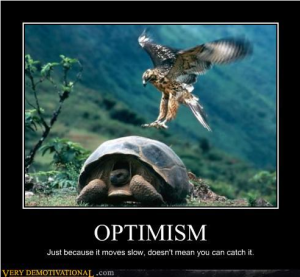
Optimism (Photo credit:verydemotivational.com)The human brain seems to be wired for forward-looking optimism.  In 2007, Tali Sharot and a team of scientists at University College London showed that people who were asked to imagine positive and negative future events consistently felt like the positive events are closer in time; the positive future events also felt closer than events in the past, whether positive or negative.  More recently, Dr. Sharot has turned her attention to the “good news/bad news effect”, our tendency to update our beliefs to reflect good news more than bad news.  Over the last few years, she and her team have identified the part of the brain responsible for this behaviour and even shown how to disrupt it.
Continue reading →

Do ants really count their steps?

09 Friday Nov 2012

Posted by sedeer in Arthropods, Humans, Hymenoptera, Mind

≈ 65 Comments

Tags

animals, ants, Behavior, biology, Cognition, Human, Insecta, Popular science, science, Science in Society

Formica rufa Several years ago, scientists published an excellent study about how desert ants find their way home after foraging.  The story got a lot of media attention; unfortunately,  much of the coverage described the ants “counting steps”, which isn’t what the researchers reported and feeds into existing myths rather than broadening our scope.  To explain what I think is wrong with that approach, I’m going to tell you a story about ants on stilts, body swapping and how we perceive space. Continue reading →

Why do men and women want different things?

30 Tuesday Oct 2012

Posted by sedeer in Evolution, Humans

≈ 12 Comments

Tags

Behavior, biology, evolution, gender, Gender role, partner, People, Popular science, relationships, romance, science, Science in Society, sex, sex differences

Always close. (Photo credit: Hannele Luhtasela-El Showk)Regular readers will probably have realized from the links I share (or from my twitter stream) that sexism and gender issues are subjects which matter to me. Unfortunately, a lot of my discussions about gender get sidetracked by a “pop evolutionary” story based on naïve evolutionary psychology. We “evolved on the plains of Africa”, the story goes, where our preference in partners was shaped by biological needs; modern gender roles and partner preferences reflect these ancestral adaptations. It’s a nice story which does a great job of justifying the existing patriarchal structure, but is it true? That’s a huge question which is unlikely to be settled by a single study. Nevertheless, Marcel Zentner and Klaudia Mitura, a pair of psychologists at the University of York, decided to take it on. Continue reading →

← Older posts
Newer posts →

Search

Donate Button with Credit Cards
Follow @inspiringsci
Follow Inspiring Science on WordPress.com

Enter your email address to follow this blog and receive notifications of new posts by email.

Join 1,699 other subscribers
RSS Feed RSS - Posts

Ongoing discussions

  • Is there evidence for natural selection? | Uncommon Descent on Natural selection: On fitness
  • istilah kesusastraan on Pointing ravens and theory of mind
  • hazratganj call girl on Pointing ravens and theory of mind
  • gomti nagar call girl on Pointing ravens and theory of mind
  • ghaziabad escorts on Pointing ravens and theory of mind
  • indore escorts nidhi nagar on Pointing ravens and theory of mind
  • wig price on Pointing ravens and theory of mind
  • aso agency on Pointing ravens and theory of mind

What’s popular now?

  • Telling left from right: which side gets the heart?
  • Natural selection: different modes
  • No secrets by the lakeside: how water affects sound
  • What lies behind illusions?
  • Redheads and pain: science or sensationalism?

Blogs to check out

  • Accumulating Glitches
  • alternative viewpoints
  • AntyScience
  • Baldscientist
  • Eyes on the Environment
  • Language Log
  • Letters of Note
  • naked capitalism
  • Raising My Rainbow
  • The Scorpion and the Frog
  • The Smaller Majority

Copyright

Creative Commons License
All text and original images by Sedeer El-Showk. Licensed under a Creative Commons Attribution-NonCommercial-NoDerivs 3.0 Unported License.

Thanks to

  • Arkadia International Bookshop
  • The Book Hive
  • The Television and Movie Store
  • Rönnels Antikvariat
Inspiring Science is part of:
  • Collective Marvelling
  • SciComm Network

I'm on ScienceSeeker-DNA

Nature
Blog Network

Categories

Archives

Create a free website or blog at WordPress.com.

Privacy & Cookies: This site uses cookies. By continuing to use this website, you agree to their use.
To find out more, including how to control cookies, see here: Cookie Policy
  • Subscribe Subscribed
    • Inspiring Science
    • Join 1,699 other subscribers
    • Already have a WordPress.com account? Log in now.
    • Inspiring Science
    • Subscribe Subscribed
    • Sign up
    • Log in
    • Report this content
    • View site in Reader
    • Manage subscriptions
    • Collapse this bar
 

Loading Comments...
 

You must be logged in to post a comment.