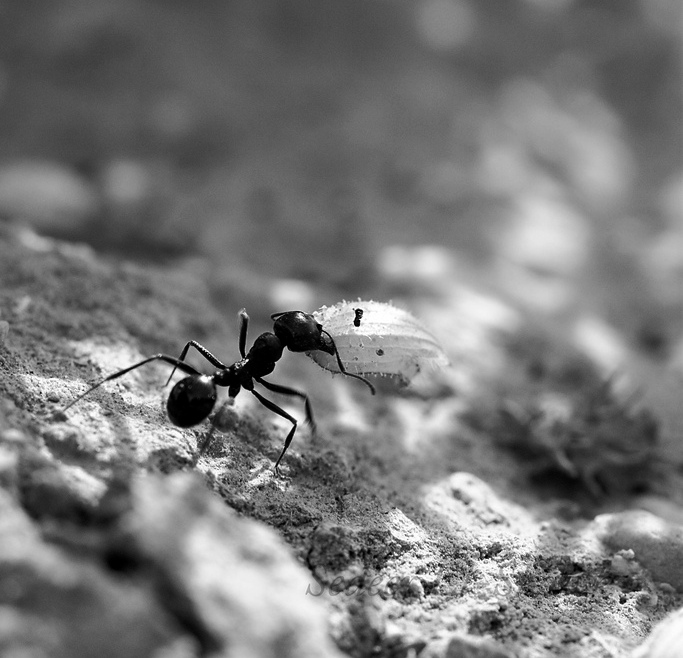
Do ants really count their steps?

Tags

, , , , , , , , ,

Formica rufa Several years ago, scientists published an excellent study about how desert ants find their way home after foraging.  The story got a lot of media attention; unfortunately,  much of the coverage described the ants “counting steps”, which isn’t what the researchers reported and feeds into existing myths rather than broadening our scope.  To explain what I think is wrong with that approach, I’m going to tell you a story about ants on stilts, body swapping and how we perceive space. Continue reading

Words of science: crepuscular

Tags

, , , , , , , ,

Spider at twilight. (Photo credit: Hannele Luhtasela-El Showk)Like many other fields, science has its own style of communication full of specific jargon and guided by unwritten rules.  Most of the posts on this blog focus on breaching this barrier to the public’s understanding and appreciation of science.  In this series, I’d like to take another approach by highlighting scientific words which have escaped the confines of jargon to reach a broader appeal because of their sound or their evocative power as metaphors.  Today’s word is crepuscular.  [Previous words of science were petrichoralluvium, and nychthemeron]
Continue reading

Found while foraging (November 3, 2012)

Tags

, , , , , , , ,

I seem to be posting these link collections just about every two weeks.  Maybe I should make that the official schedule?  Anyway, here’s my latest collection of tidbits from the web for you to enjoy.  Feel free to add more in the comments if you’d like.
Continue reading

Why do men and women want different things?

Tags

, , , , , , , , , , , , ,

Always close. (Photo credit: Hannele Luhtasela-El Showk)Regular readers will probably have realized from the links I share (or from my twitter stream) that sexism and gender issues are subjects which matter to me. Unfortunately, a lot of my discussions about gender get sidetracked by a “pop evolutionary” story based on naïve evolutionary psychology. We “evolved on the plains of Africa”, the story goes, where our preference in partners was shaped by biological needs; modern gender roles and partner preferences reflect these ancestral adaptations. It’s a nice story which does a great job of justifying the existing patriarchal structure, but is it true? That’s a huge question which is unlikely to be settled by a single study. Nevertheless, Marcel Zentner and Klaudia Mitura, a pair of psychologists at the University of York, decided to take it on. Continue reading

Gut bacteria and diabetes: the saga continues

Tags

, , , , , , , , , ,

Low-temperature electron micrograph of a cluster of E. coli bacteria, magnified 10,000 times. Each individual bacterium is oblong shaped. (Photo credit: Wikipedia)Type 2 diabetes is a serious global epidemic, having grown from 30 million cases to nearly 300 million over the past three decades. Although several recent studies have shown a link between type 2 diabetes and our gut bacteria, we’re still only at the dawn of learning about the microbiome. There’s a great deal we don’t yet know, including what kinds of bacteria live in our gut and how they go about making a living there. In a paper published in the September issue of Nature, a team of scientists from China and Denmark used whole genome sequencing technologies to overcome these gaps in our knowledge and get some more clues about the relationship between our gut bacteria and this disease. Continue reading

Telling left from right: which side gets the heart?

Tags

, , , , , , , ,

This was originally a guest post on The Trenches of Discovery. Thanks, Shaun!

Selection of internal organs in human anatomy. (Image credit: Wikipedia)One out of every 8,000 humans is born with some of their internal organs on the wrong side of their body, a condition which can have serious medical consequences. Although we’re usually described as symmetric, that’s only superficially true. Like other vertebrates, we look symmetric from the outside but our internal organs show left-right asymmetry; unless you happen to be a Time Lord, you have only one heart which is normally located on the left side of your chest.  Changes to the organization of the internal organs can lead to cardiac defects, misalignment of the bowel and other serious problems.  Many genes are known to play a role in establishing this asymmetry, but we still don’t fully understand its evolutionary and developmental origins.  Earlier this year, a paper published in the journal PNAS described how this asymmetry is established by  subcellular components early in embryonic development.

Continue reading