How plants smell smoke

Tags

, , , , , , , , ,

Fire on Shasta-Trinity NF (Photo credit: USFS Region 5)In response to my recent post about the dynamic life of plants, reader tmso asked about whether plants can sense and respond to smoke. I still haven’t found anything about an immediate response to smoke, but I’ve learned quite a bit about how smoke and fire affect germination. Many plants, especially in areas with a Mediterranean environment, are ‘fire followers’ that germinate after a fire has cleared the landscape. Some of them have seeds coated with flammable oils which release a lot of heat when they burn, causing the seed to germinate. Other plants, though, don’t respond to the fire itself, but germinate and grow better in response to smoke. Over the past decade, we’ve started to understand how these plants sense smoke, though there’s still a lot discover. (Thanks for the question, tmso!) Continue reading
No secrets by the lakeside: how water affects sound

Tags

, , , , , , , ,

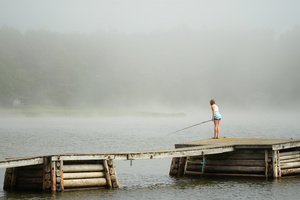
Fishing (Photo credit: Hannele Luhtasela-El Showk)Summer in Finland can be tricky. Most people retire to their summer cottages, many of which are located by one of the country’s 190,000 lakes; the cottages provide a respite from the metropolitan hustle, a quiet interlude with space to pause and reflect. It’s easy to feel comfortably isolated, but you quickly learn to be cautious about baring your soul by the lakeside. Sitting by the water’s edge last week, my partner and I were struck by how easily we could hear our neighbours across the water. This isn’t a special property of Finland or even of Finnish lakes. It’s just that sound travels better over water and Finland has quite a lot of lakes dotted with lakeside cottages. Continue reading

A short break

I’m taking a holiday for the next two weeks and won’t have convenient Internet access, so Inspiring Science will be quiet for a little while.  Thanks to everyone who’s been reading & commenting; it’s been fun writing for you and watching the blog grow! Enjoy August!

The forgotten life of plants

Tags

, , , , , , , , , , , ,

Peter Newell's illustraion of The Garden of Live Flowers (Image credit: Wikimedia commons)In Lewis Caroll’s Through the Looking Glass, Alice wanders into a garden with flowers that can talk — the “garden of Live Flowers”.  Of course, all plants are alive, but here the flowers are called “live” because they can talk.  One of the greatest examples of human arrogance might be our attitude towards plants.  We treat plants as objects, as part of the background, as mere things without any agency.  We tend to forget that they’re dynamic, complex living creatures that react and respond to their environment — just in unfamiliar ways and on a different timescale.  Continue reading

Correction: Plants micro-RNAs might not regulate animal genes

Tags

, , , , , , , , , , , , ,

Around a year ago I wrote about a study which showed that micro-RNAs from plants that were eaten could regulate genes in the animal that ate them.  It was an exciting and important finding.  The study claimed that the miRNAs survived passage through the digestive tracts of mice, got into their bloodstream and traveled to their liver, where they regulated genes involved in cholesterol metabolism.  This week I read a post on Virginia Hughes’ blog Only Human where she discusses several follow-up studies which haven’t been able to reproduce the original results.  That doesn’t necessarily mean the study was wrong, but it certainly raises doubts.  In her post, Virginia also links to a rebuttal letter she received from the author of the original study, so it looks like the debate is on!  I’ll try to keep an eye on the subject and report back about it as things develop, but in the meantime read Virginia’s excellent summary of the current state of affairs.  Showing that creatures can directly regulate genes in organisms of another kingdom of life would be a major finding, so I’m really glad that there’s debate about it.  That’s how science should work: we should try to repeat studies, remain critical and open-minded, and challenge each other.

Found while foraging (July 3, 2013)

Tags

, , , , , , , , , , , ,

I’m offline this week as I’ve retreated to one of my favourite places in the world for a holiday. I was too busy to prepare a post before leaving, but fortunately it’s about time for another Found while foraging.  Hopefully this post will be automatically published on Wednesday while I’m happily reading in front of a fire in a lovely cottage unburdened by the trappings of modernity — power, plumbing, and internet.  I’ve never pre-scheduled a post for publication before, so I hope it works.  I won’t link to many Scitable posts this time, but do pop over and have a look anyway; there’s some great stuff on there.  As always, though, feel free to add more links in the comments!
Continue reading