• About the blog
  • About Sedeer
  • Series
    • Words of Science
    • Discussions
    • Foraging
    • Natural Selection
    • QM Workshop
  • Contact me
  • Accumulating Glitches
  • Collective Marvelling

Inspiring Science

~ Casting light on great ideas

Inspiring Science

Category Archives: Evolution

The Language of DNA

29 Tuesday Apr 2014

Posted by sedeer in Evolution, Genetics

≈ Leave a comment

Tags

biology, codon, DNA, evolution, Genetics, language, Popular science, redundancy, science, translation

One of the striking things about the genetic code is the remarkable way it twists back on itself, combining redundancy and utility in a simple, elegant language. Many of us are introduced to the basic concept in school, but that introduction often leaves out the wrinkles — some of them newly discovered — which give the system its resilience and precision. Despite their complexity, most of these tricks are pretty easy to explain with linguistic analogies, which is precisely what I’m going to try in this post. Continue reading →

Speciation in Reverse

07 Monday Apr 2014

Posted by sedeer in Evolution

≈ Leave a comment

Tags

animals, biology, birds, Darwin, evolution, finches, galapagos islands, Popular science, science, speciation

I don’t usually advertise my Accumulating Glitches posts on here, but I decided to make an exception for today’s post. It’s about a relatively straightforward study that raises a host of interesting questions which I thought some of you might find interesting. Here’s an excerpt to give you an idea:

Darwin’s finches have become a textbook example in evolutionary biology, speciating as they adapted to different environments in their spread through the Galapagos islands. In the past two decades, the opposite has been happening on Floreana island in the south of the archipelago, according to a paper published in the journal American Naturalist. The opposite of speciation, however, isn’t necessarily extinction — at least, not in the familiar sense of a species dying out. Another way for speciation to roll backwards is through hybridization, a process that raises many more (and more interesting) questions than ‘straightforward’ extinction.

Click to continue reading on Accumulating Giltches…

Ref
Kleindorfer S, O’Connor JA, Dudaniec RY, Myers SA, Robertson J, & Sulloway FJ (2014). Species collapse via hybridization in Darwin’s tree finches. The American naturalist, 183 (3), 325-41 PMID: 24561597

Dying for sex

12 Wednesday Feb 2014

Posted by sedeer in Evolution, Mammals

≈ Leave a comment

Tags

animals, Behavior, biology, Education, evolution, mating, Popular science, reproduction, science, sex

Unfortunately, I’ve been too busy to attend to Inspiring Science this week. Rather than putting out a rushed post, I decided to republish this piece which I originally wrote for Accumulating Glitches last year. I hope you like it!

(Photo credit: Michael Barritt & Karen May, via Wikimedia Commons)Some spiders get eaten by their mates, and male salmon famously fight to the death for access to females, but we generally don’t think of reproduction being quite as risky for mammals. We may prance and pose or jockey for attention, and mating might even be quite painful, but it’s usually not lethal. Among mammals, “live to mate another day” seems to be the guiding principle. Exceptions to this rule are found in the dasyurids and didelphids, groups of small carnivorous marsupial species living in Australia and South America, respectively. “These species experience extreme sexual behaviour,” said Dr. Diana Fisher of the University of Queensland. Males and females mate with multiple partners and matings can go on for many hours. Afterwards, the males all die. Continue reading →

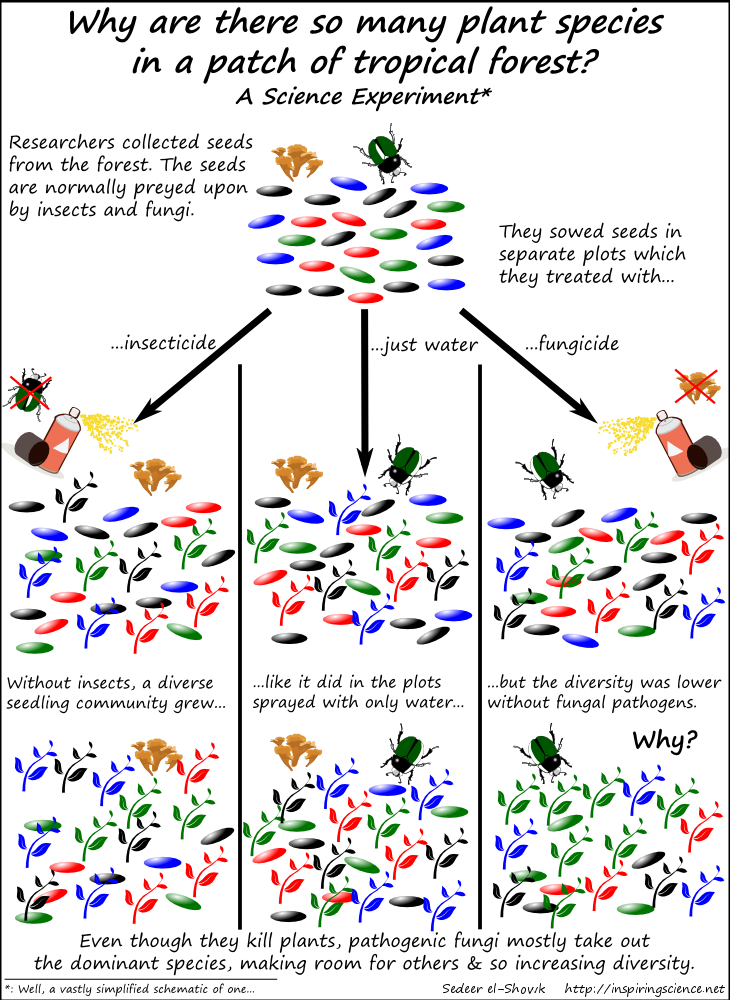
Why are there so many plant species in tropical forests?

29 Wednesday Jan 2014

Posted by sedeer in Conservation, Evolution, Insects, Plants

≈ 5 Comments

Tags

biology, density, diversity, forests, fungi, pathogen, plants, Popular science, science, tropical forests

Diversity in Forests Continue reading →

Talkin’ ’bout Evolution

02 Wednesday Oct 2013

Posted by sedeer in Evolution

≈ Leave a comment

Tags

biology, epigenetics, evolution, Human, Popular science, science, virus

Unfortunately, I haven’t had time to write anything for Inspiring Science this week, so instead I decided to link to a few of my recent posts on Accumulating Glitches instead. I wrote two posts, Tracking the Evolution of a Virus and Antibiotics and Applied Evolution, about evolutionary sories which might affect our day-to-day lives; I introducted them saying: Continue reading →

The viruses that made us

29 Wednesday May 2013

Posted by sedeer in Development, Evolution, Genetics, Humans, Mammals

≈ 10 Comments

Tags

biology, DNA, evolution, Genome, horizontal gene transfer, Popular science, science, virus

Enterobacteria phage λ, Lambda phage-coliphage λ, José F. Vargas, http://elnefashu.deviantart.com/ (Photo credit: PHYLOMON)Viruses make their living by breaking into cells and using the machinery and energy in the cell to reproduce.  Once inside, some viruses immediately hijack the cell and make copies of themselves which burst out into the world to infect new cells.  Other viruses take a staid approach, though.  Instead of taking over the cell, they quietly slip a copy of their genes into its DNA.  When the cell divides, it copies the newly acquired viral genes along with the rest of its genome.  It’s a better deal for the virus, since all of the cell’s descendants will be carrying viral genes which can eventually come out of hiding to commandeer the cell and replicate.  A really lucky virus is one that finds itself inside an egg cell.  Getting into the DNA of a single cell means getting copied into all of its daughter cells, but getting into the DNA of an egg cell means getting copied into every cell in the organism that grows from the egg…and from there into all of the organism’s offspring.  Lucky viruses that succeed in pulling off that trick can still break out and cause trouble, but they can also become integrated into their host’s genome; instead of struggling to reproduce, they can then just kick back and enjoy the ride while we lumber along, making copies of them whenever we make new cells or have children. Continue reading →

← Older posts
Newer posts →

Search

Donate Button with Credit Cards
Follow @inspiringsci
Follow Inspiring Science on WordPress.com

Enter your email address to follow this blog and receive notifications of new posts by email.

Join 1,699 other subscribers
RSS Feed RSS - Posts

Ongoing discussions

  • Is there evidence for natural selection? | Uncommon Descent on Natural selection: On fitness
  • istilah kesusastraan on Pointing ravens and theory of mind
  • hazratganj call girl on Pointing ravens and theory of mind
  • gomti nagar call girl on Pointing ravens and theory of mind
  • ghaziabad escorts on Pointing ravens and theory of mind
  • indore escorts nidhi nagar on Pointing ravens and theory of mind
  • wig price on Pointing ravens and theory of mind
  • aso agency on Pointing ravens and theory of mind

What’s popular now?

  • Telling left from right: which side gets the heart?
  • Natural selection: different modes
  • No secrets by the lakeside: how water affects sound
  • What lies behind illusions?
  • Redheads and pain: science or sensationalism?

Blogs to check out

  • Accumulating Glitches
  • alternative viewpoints
  • AntyScience
  • Baldscientist
  • Eyes on the Environment
  • Language Log
  • Letters of Note
  • naked capitalism
  • Raising My Rainbow
  • The Scorpion and the Frog
  • The Smaller Majority

Copyright

Creative Commons License
All text and original images by Sedeer El-Showk. Licensed under a Creative Commons Attribution-NonCommercial-NoDerivs 3.0 Unported License.

Thanks to

  • Arkadia International Bookshop
  • The Book Hive
  • The Television and Movie Store
  • Rönnels Antikvariat
Inspiring Science is part of:
  • Collective Marvelling
  • SciComm Network

I'm on ScienceSeeker-DNA

Nature
Blog Network

Categories

Archives

Create a free website or blog at WordPress.com.

Privacy & Cookies: This site uses cookies. By continuing to use this website, you agree to their use.
To find out more, including how to control cookies, see here: Cookie Policy
  • Subscribe Subscribed
    • Inspiring Science
    • Join 1,699 other subscribers
    • Already have a WordPress.com account? Log in now.
    • Inspiring Science
    • Subscribe Subscribed
    • Sign up
    • Log in
    • Report this content
    • View site in Reader
    • Manage subscriptions
    • Collapse this bar
 

Loading Comments...
 

You must be logged in to post a comment.